
Helicopter Hoist Operator Training — Why the Gap Exists and What Good Looks Like

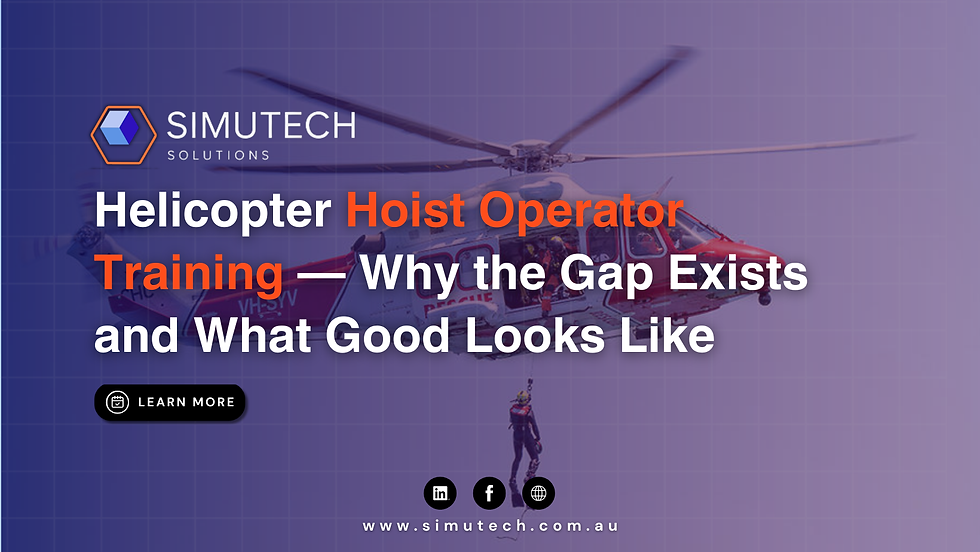
There are few roles in aviation that carry as much consequence as the Helicopter Hoist Operator.
In a search and rescue mission, the Hoist Operator is the crew member managing the cable from the back of the aircraft, often in darkness, over water, in weather conditions that have already put someone's life at risk. They are communicating continuously with the pilot, guiding the aircraft to position, managing the load, and making real-time decisions that directly determine whether the person below gets home safely.
It is a high consequence, high complexity, full crew task. And in Australia and New Zealand right now, the structured training pathways to develop and maintain that capability are not keeping pace with demand.
That gap was one of the most consistent themes that came out of our conversations at RotorTech on the Gold Coast. Operators across EMS and SAR are feeling it. And it deserves a direct, honest conversation about why it exists and what genuinely good HHO training looks like.
It's a Full Crew Mission Not a Single Skill
The first thing to understand about hoist training is the frame it needs to sit within.
A hoist operation is not a pilot task with a crew member assisting. It is a full crew mission concept, where responsibilities shift dynamically across the team throughout the operation. The pilot, hoist operator, and any rescue or medical personnel on board are a group of interdependent individuals working toward the same outcome. The crew depends on each other's knowledge, skills, and situational awareness from the moment they are on duty to the moment the task is complete.
That framing, drawn from EASA's Helicopter Hoist Operation Pilot Training Guide, has important implications for how training is designed and delivered. Training that treats the HHO role in isolation, without integrating it into a full crew resource management context, misses the point of the mission entirely.
Effective hoist training is crew training. And that makes it significantly more complex to deliver than a standalone skills programme.
Why the Gap Exists in Australia & New Zealand
Australia and New Zealand has a rotary wing community that is small, geographically dispersed, and operating across an enormous range of mission types. The EMS and SAR sectors in particular face a set of compounding pressures that make hoist training consistently difficult to deliver at the standard the mission demands.
Access to qualified training environments is limited.
Conducting live hoist training requires an appropriate aircraft, a qualified instructor, suitable airspace, and in many cases specific environmental conditions. Coordinating all of those elements consistently, at the frequency that competency development requires, is genuinely difficult for most operators.
The training is time and cost intensive when conducted entirely in the aircraft.
Live hoist training consumes significant flight hours and places real wear on aircraft systems. For operators running lean fleets on operational commitments, finding available aircraft time for training is a constant challenge. The aircraft that is in the air doing training is not available for the mission it was built to support.
Standardised pathways are underdeveloped.
Unlike pilot licensing, where the regulatory pathway is clearly mapped, hoist training has historically been developed operator by operator, with significant variation in curriculum, assessment standards, and delivery method. The result is a landscape where training quality is inconsistent and crew currency is difficult to verify objectively.
CASR Part 138 transition requirements have added pressure.
Rotorcraft operators under Part 138 have been navigating a significant regulatory transition, with new training and checking system requirements that came into effect in mid-2025. For operators already stretching their training resources, absorbing those requirements while maintaining operational output has been genuinely challenging.
The gap is not the result of operators not caring. It is the result of structural constraints that make high quality HHO training hard to deliver consistently at scale.
Where Simulation Changes the Equation
The most significant shift in HHO training over the past decade has been the maturation of simulation capability specifically designed for hoist operations.
This is not simply about putting a pilot in a full flight simulator. Effective HHO simulation requires a dedicated hoist operator station, integrated with the flight simulator, that replicates the physical and procedural experience of managing the cable from the rear of the aircraft. The pilot and hoist operator train together, in a simulated environment, as a crew. aThe benefits of this approach are well documented in the global SAR and HEMS community.
Simulation allows new operators to make mistakes and experience emergencies in a controlled environment that can be paused, reviewed, and repeated safely. That capability does not exist in live training. The consequence of an error in the simulator is a learning opportunity. The consequence of the same error in the aircraft, over water, at night, is potentially catastrophic.
The cost and efficiency case is equally compelling. Synthetic mission training has been shown to reduce live flight training time by an average of 50%, delivering significant savings for operators who are already under pressure on aircraft availability and training budgets. For Australian and New Zealand operators who in many cases are conducting or procuring training offshore, those savings are even more meaningful.
Modern hoist simulation platforms offer winch cable control across multiple axes, including emergency scenarios such as engine failure and cable dynamics under load. They are designed specifically to improve pilot and hoist operator communication during missions, and they support customisable scenario development for SAR, EMS, and other operational contexts.
The technology hasn't quite yet reached a point where it is a substitute for live training. Bur rather it's a structured pathway that makes live training more effective, more efficient, and more consistently safe.
What Good Helicopter Hoist Operator Training Actually Looks Like
For operators working to close the gap in their hoist training capability, a well-designed programme has several defining characteristics.
It is built around the mission, not the equipment.
The training curriculum starts with the operational context, the types of rescues the crew will conduct, the environments they will operate in, and the emergencies they need to manage, and works backward to identify the skills and knowledge required. The simulator or training device is a delivery mechanism for that curriculum, not the starting point.
It integrates the full crew.
Hoist Operator training is developed and delivered alongside Pilot training. Communication protocols, crew resource management, and shared situational awareness are trained as a system, not as separate modules that happen to exist in the same programme.
It provides objective performance data.
One of the most undervalued capabilities of simulation-based training is the ability to collect and analyse performance data across training sessions. Subjective instructor assessment has historically been the primary evaluation tool for hoist training. Simulation platforms that generate objective performance metrics allow training managers to track crew development over time, identify consistent weaknesses, and demonstrate competency with evidence that stands up to regulatory scrutiny.
It is progressive and structured.
Initial assessments of capability inform the early training programme. As competency develops, scenarios increase in complexity and fidelity. Emergency and distraction training comes after foundational skills are established, not alongside them. The programme has a logical architecture that reflects how humans actually build complex skills.
It connects to the regulatory framework.
Training conducted in support of CASR Part 138 aerial work operations and the associated training and checking requirements needs to be documented, assessed, and verifiable. A well-designed HHO training programme is built with that framework in mind from the outset, not retrofitted to it after the fact.
The Role of an Independent Training Partner
For most EMS and SAR operators in Australia and New Zealand, building a fully self-contained HHO simulation and training capability from scratch is not a realistic first step. The capital investment, the regulatory engagement, and the curriculum development work required are significant.
What is more realistic for many operators is a partnership model, where an independent training and technical partner helps to support the training requirement, identify the right solution for the operation, and navigate the pathway to a capability that is genuinely fit for purpose.
This is work we are directly involved in. We bring together capability in simulation technology, regulatory understanding, and practical experience in the rotary wing sector to help operators work through the full picture. That includes understanding what training outcomes are needed, what simulation capability is appropriate, how it integrates with live training, and what the approval pathway looks like.
For operators who are earlier in the journey, that process often starts with a conversation about what the operation actually needs before any discussion of technology or procurement.
That is, in many ways, the most valuable place to start.
A Community Worth Investing In
The EMS and SAR communities in Australia do extraordinary work.
The crews who operate in these environments are responding to genuine emergencies, often in conditions that most people will never encounter. The standard of training they receive directly affects the outcomes of those missions.
Getting Hoist Operator training right is most definitely not an administrative exercise, but rather it's an investment in the capability of the people who go out to bring others home safely.
The gap in accessible, structured, simulation-supported hoist training in Australia and New Zealand is real. But it is also absolutely closeable. The technology exists. The regulatory framework, while complex, is navigable. And the community of operators who care deeply about doing this well is engaged and looking for solutions.
The conversations we had at RotorTech made that very clear.


Comments