
RotorTech 2026 - A Grounded Look at Where the Australian Rotorcraft Industry Is Heading


After a few days on the floor at RotorTech on the Gold Coast, one thing became clear.
The Australian rotorcraft community knows exactly what it needs.
It just wants help getting there.
There is a sense of clarity in this industry right now. A quiet confidence. Less noise around what might be possible one day, and more honest conversation about what is needed right now, and how to go about it properly.
For a first time co-exhibitor, it was an encouraging place to land.
RotorTech 2026 - A Small Community, Deeply Connected
One of the first things that stands out at RotorTech is the scale.
This is not a huge international expo. It is a focused, deliberately sized event that reflects the nature of the Australian rotary wing industry itself.
Small. Tight knit. And remarkably well connected.
Over the course of the event we had the chance to meet a handful of new faces and reconnect with people we have known for years across different corners of the industry.
Those conversations, whether brief or extended, carry a particular kind of value that is hard to replicate anywhere else.
You get a real sense of what the industry is thinking. What operators are feeling. Where the pressure is building, and where confidence is growing.
What struck us most was how aligned that conversation was. The challenges people are raising, the priorities they are setting, and the direction they see the industry heading, it largely reflects what we are seeing and hearing in our own work every day.
That kind of alignment matters. It tells you the industry is paying attention to the right things.
Training Is the Conversation
If there was one theme that came up more than any other across our time at RotorTech, it was training.
Not in a vague, general sense. In a specific, operational, urgent sense.

Operators are feeling the pressure of growing training requirements and, in many cases, are working hard to understand how to meet them effectively. The discussions we had were not hypothetical. They were practical. Grounded in real operational needs and real gaps that exist right now.
A topic that surfaced repeatedly was Helicopter Hoist Operator training. This is a specialised, high consequence skill set, and finding quality, accessible training solutions for HHO crews is a genuine challenge for a number of operators across the country. The demand is there. The structured pathways to meet it, in many cases, are not.
These are the kinds of problems that deserve more than a general answer. They require operators and training partners to sit down together, understand the mission profile, and work out what a fit for purpose solution actually looks like.
We were glad to be part of those conversations.
Where Do We Even Start?
One of the most encouraging patterns across the event was the number of operators who came to us with a version of the same question.
We know we need to get into simulators. We just aren't sure where to start. Can you help us define what we actually need and work out what our options are?
This is exactly the kind of engagement we exist for.
The decision to invest in simulation capability is not a simple one. The range of options is broad, the regulatory landscape has its own requirements, and the wrong decision early can be a costly one to unwind. Operators who are new to simulation do not always need someone to sell them a product. They need someone to help them understand the problem first.
That process, defining the requirement clearly before committing to a solution, is something we take seriously. And the fact that operators are actively seeking that kind of structured guidance is a healthy sign for where the industry is heading.
The Value of Being in the Room
Beyond the specific conversations, RotorTech is a reminder of why physical events still matter.
The rotary wing community in Australia is small enough that relationships carry real weight. Trust is built over time and through proximity. Seeing familiar faces, being introduced through shared connections, having an unscheduled conversation that turns into something meaningful, none of that happens on a video call.

For those of us working in technical and training support roles, it is also an opportunity to step back from the day to day and take in the bigger picture. To hear what operators across different sectors and missions are experiencing. To understand how challenges differ between EMS, search and rescue, utility and offshore operations, and what common threads run across all of them.
That perspective sharpens the work we do when we return.
A Focused Industry
If there is one way to describe the overall feeling at RotorTech 2026, it is focused.
Not slow. Not cautious. Just clear eyed about what matters.
Operators know their missions. They understand their gaps. And they are actively looking for partners who can help them close those gaps in a practical, considered way.
Training is being recognised not as a support function, but as a core operational requirement.

Simulation is moving from a concept that some operators are curious about to one that many are actively working to define and implement.
And the community itself, small as it is, continues to demonstrate the kind of collaboration and shared purpose that makes it genuinely good to be part of.
Looking Ahead
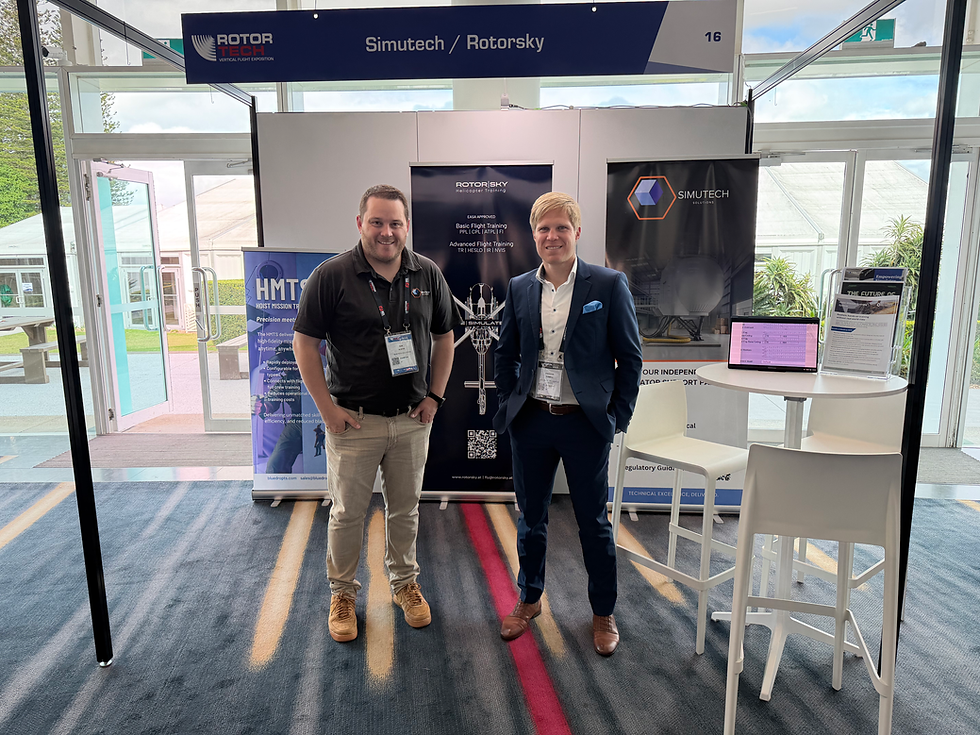
We came to RotorTech as co-exhibitors alongside RotorSky and Marksman Aviation Group, and we left with a clearer sense of where the opportunities are, and a stronger set of connections to build on.
The conversations started on the Gold Coast will continue. Some will turn into projects. Some will develop over time. All of them were worth having.
If you were at RotorTech and we did not get the chance to connect, or if the topics raised in this post resonate with challenges you are working through, we would welcome the conversation.


Comments