
How Realistic Are Flight Simulators, really?


In commercial aviation, a newly hired airline pilot can complete their entire type rating, pass their checkride, and command a 150-ton passenger jet carrying hundreds of passengers without ever having touched the controls of the physical aircraft prior to revenue operations. This remarkable regulatory milestone (known as Zero Flight Time Training (ZFTT)) relies entirely on modern Level D Full Flight Simulators (FFS).
But how realistic are these multi-million-dollar devices, really?
Does a simulator replicate every physical law of flight, or is it an exquisitely engineered perception replicating machine?
Physical Fidelity vs. Perceptual Realism
To evaluate simulator realism, aviation researchers and regulatory bodies distinguish between physical (engineering) fidelity and perceptual (functional) realism.
Engineering (Physical) Fidelity
Physical fidelity measures how accurately a flight simulator replicates the physical hardware, aerodynamic equations, and environmental mechanics of the real aircraft. It answers an engineering question: Does the simulator's dynamic response match the aircraft's instrumented flight test data within the specified strict tolerances?
Perceptual Realism and Functional Fidelity
Perceptual realism (often termed functional or training fidelity) focuses on human sensory processing and behavioural transfer. It evaluates whether the simulator provides the necessary visual, vestibular, acoustic, and tactile cues for a pilot to execute manoeuvres as they would in the real aircraft.
Research demonstrates that absolute physical identity is not required to achieve operational realism. During intense, realistic training scenarios, pilots can experience dissimulation; they quickly forget they are inside a ground-based simulator and behave exactly as though they are operating the real machine, experiencing what veteran instructors describe as "the smell of fear and sweat". The process of forgetting you're in a training device is also often referred to as immersion.
The Gold Standard - The Level D Full Flight Simulator
Under regulatory standards such as FAA's 14 CFR Part 60 and EASA's CS-FSTD(A), Full Flight Simulators are qualified across Levels A through D, with Level D representing the highest recognised standard of simulation fidelity.
Full Flight Simulator (FFS) Tiers
Level A & B
Enclosed cockpit, basic motion/visual cues, generic or basic flight validation.
Level C
6DOF motion, 180°x40° collimated visuals, windshear, UPRT, ≤150ms transport delay.
Level D
Highest standard, flight-test correlated aerodynamics, extended buffet/motion cues, ZFTT.
Subsystem Architecture of a Level D Simulator
A flight simulator achieves its realism through four tightly integrated subsystems:
1. Flight Dynamics & Aerodynamic Validation
The mathematical flight model is powered by a comprehensive aerodynamic database derived directly from instrumented flight testing of the physical aircraft. Compiled into a Qualification Test Guide (QTG), the simulator's control forces, accelerations, and performance limits must fall within narrow regulatory tolerances. Total transport delay (the system latency from a pilot's control input to motion and visual response) must not exceed 150 milliseconds, preventing control lag and pilot-induced oscillations.
2. Collimated Visual Optics
Level D visual display systems provide a continuous out-of-the-window field of view of at least 180 degrees horizontally and 40 degrees vertically per pilot station. Level D visual systems utilise collimated optics (curved mirrors and back-projection) to project light rays at optical infinity. This eliminates parallax distortion across the cockpit, allowing both the captain and first officer to perceive almost identical, geometrically accurate external scenes.
3. Six-Degree-of-Freedom (6DOF) Motion Bases
Level D simulators are mounted on hydraulic or electric 6DOF motion platforms capable of pitching, rolling, yawing, heaving, surging, and swaying. These systems supply acceleration onset cues and specialised buffet simulation, reproducing vibrations during aerodynamic stalls, thrust reverses, runway joint impacts, and touchdown contact.
4. Cockpit Replication & Avionics Integration
Regulations require a full-scale, exact replica of the aircraft flight deck. All switches, control columns, circuit breakers, and instrument displays match the real aircraft in tactile force and appearance. Modern simulators often execute rehosted flight software from aircraft line-replaceable units (LRUs), ensuring that system logic, cascading electrical failures, and caution/warning alerts function identically to the real aircraft.
Zero Flight Time Training (ZFTT)
Because Level D simulators achieve operational equivalence with the aircraft, regulators authorise Zero Flight Time Training (ZFTT). Qualified commercial pilots can complete transition training and type ratings entirely within the simulator, stepping into the physical aircraft for the first time during scheduled revenue flights.
The Value of Realism
The high fidelity of Level D simulators delivers major benefits to pilot proficiency and aviation safety:
Safe Mastery of High-Risk Scenarios
Simulators enable flight crews to practice life-threatening emergencies—such as uncontained engine failures, severe windshear, dual hydraulic loss, and upset prevention and recovery training (UPRT) stall entries—that would be unacceptably hazardous to attempt in an actual aircraft.
Procedural Repetition & Muscle Memory
Instructors can reset flight conditions instantaneously. A pilot can practice ten instrument landing system (ILS) approaches or engine-out drills in an hour, building muscle memory without wasting time flying traffic patterns or holding for air traffic control.
Enhanced Decision-Making and Crew Resource Management (CRM)
Instructors can freeze scenarios, introduce compounding failures, and alter weather dynamically, building calm decision-making under high workload.
Economic & Environmental Sustainability
Flight simulators eliminate fuel consumption, airframe wear, and aircraft carbon emissions while significantly lowering training expenses for commercial airlines.
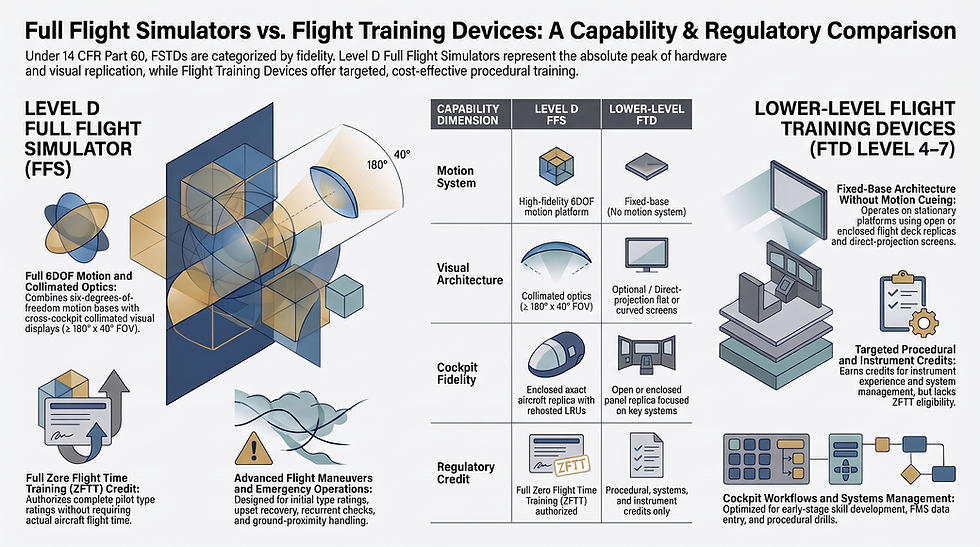
Level D FFS vs. Lower-Fidelity Devices
While Level D simulators represent the highest level of realism (and cost), they exist alongside a broader hierarchy of Flight Simulator Training Devices (FSTDs). Not every training objective requires a full-motion platform.
Feature / Capability | Flight Training Device (FTD Level 4–7 / Level 1–2) | Full Flight Simulator (FFS Level C & D) |
Motion Base | None (Fixed-base platform) | High-fidelity 6DOF motion platform |
Visual Architecture | Direct-projection screens or flat displays (Optional on lower levels) | Wide-angle collimated optics (180dev x 40deg) FOV) |
Cockpit Layout | Open panel or enclosed replica of specific systems | Fully enclosed, exact 1:1 aircraft replica |
Primary Focus | Systems management, procedures, checklist flows, FMC programming | Manoeuvre handling, landing flare, UPRT, emergency drills, ZFTT |
Zero Flight Time Credit | Unauthorised | Authorised (Level D) |
Lower-Tier Devices - FTDs, FNPTs, and BITDs
Flight Training Devices (FTDs): Ranging from open touchscreen panels (Level 4) to enclosed cockpit replicas with type-specific flight models (Level 7 / Level 2), FTDs lack motion platforms. They excel at teaching system operations, flight management computer (FMC) procedures, and normal/abnormal flows at lower operating costs.
Flight Navigation Procedures Trainers (FNPTs) & BITDs: European regulatory categories (FNPT I, II, and Basic Instrument Training Devices) serve flight schools, providing standardized instrument navigation and multi-crew cooperation (MCC) practice.
The Capability Signature Concept
Aviation authorities are increasingly adopting task-to-tool frameworks, such as the FSTD Capability Signature (FCS) concept outlined in ICAO Doc 9625 and FAA initiatives - and is now formally in place under EASA's new CS-FSTD. Rather than forcing all training into rigid device tiers, specific training tasks are matched to required feature fidelities (None, Generic, Representative, or Specific). This allows lower-tier devices like Level 5 FTDs to earn credit for tasks such as Heads-Up Display (HUD) familiarisation without requiring a Level D motion base.
Technological Boundaries - Where Realism Meets Physical Limits
Despite their advanced engineering, Level D simulators face inherent physical and perceptual limitations:
Motion Washout Limitations
Because flight simulators are constrained by room dimensions and actuator travel limits, they cannot sustain continuous linear acceleration. Motion systems use washout algorithms to tilt the cab and subtly return the platform to centre below human perception thresholds, relying on visual cues to sustain the sensation of sustained acceleration.
Visual Depth & The Landing Flare
Because collimated optics project visual scenes to optical infinity, they lack binocular depth cues such as stereopsis and accommodation. While inconsequential during high-altitude flight, this creates visual challenges during the landing flare, where pilots rely on ground-plane texture and visual perspective to judge height above the runway.
The Perception Machine That Saves Lives
Level D Full Flight Simulators do not need to be 100% physically identical to real aircraft in every single variable. But, by carefully calibrating visual collimation, 6DOF motion cueing, flight-test aerodynamic models, and exact cockpit hardware, Level D simulators achieve engineered operational equivalence. They provide pilots with a safe, forgiving, and rigorous environment to rehearse and master complex skills; helping make modern commercial air travel extraordinarily safe.


Comments