
Discussion - From Pilot Training to Passenger Readiness


How eVTOL Aircraft Could Redefine Pilot Training
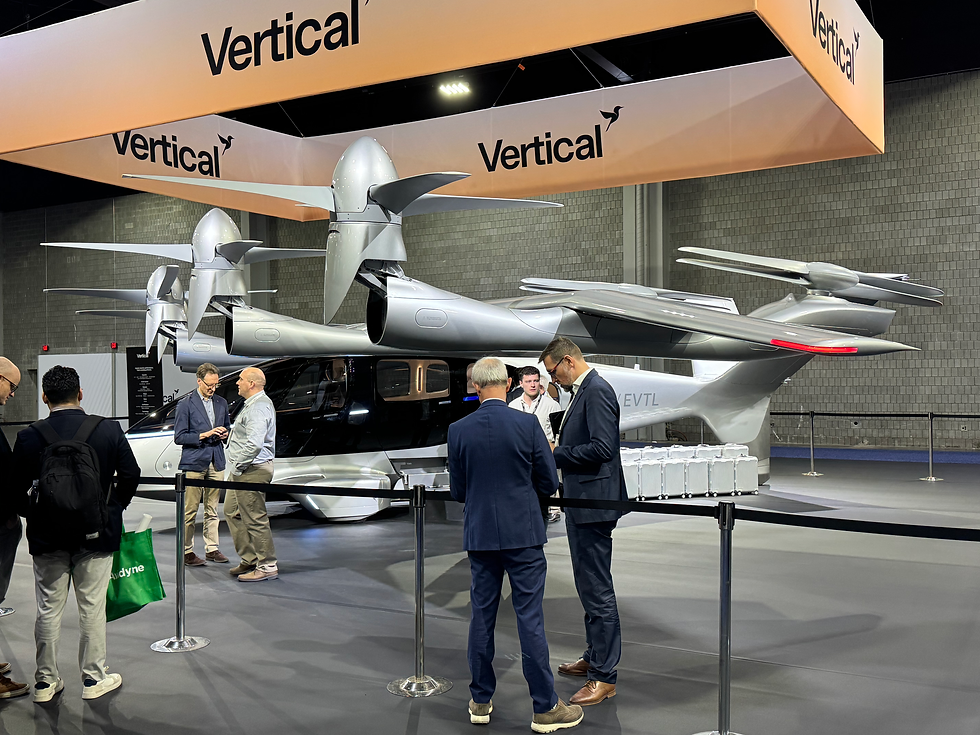
At Verticon in Atlanta this year, it was hard to ignore the obvious shift.
Among the helicopters and other familiar vertical lift platforms sat something different. Aircraft that looked familiar enough to belong in aviation, yet different enough to challenge some of its longest standing assumptions.

Several of the VTOL platforms on display were designed to do more than fly; they were designed to operate with reduced pilot input, and in some cases, no pilot at all. Autonomy of flight is no longer a distant concept. It is being built, tested and quietly introduced. After the hype of the late 20-teens and early 2020s, the industry's most successful companies are simply getting on with the business of building, testing and bringing to market their take on what makes VTOL so compelling.
Most of the discussion around these aircraft tends to focus on certification, airspace integration and technology maturity. Of course, all important topics. But there is another question that feels less explored, and arguably just as important. If there is no pilot onboard, who is responsible for the passenger? And more specifically, what does training look like in a world where the person sitting in the seat may no longer be a trained aviator, but an everyday user?
A Shift in Responsibility
Traditional aviation has always been built around a clear structure of responsibility.
Pilots are trained to manage the aircraft. Cabin crew are trained to manage the passengers. Technicians are trained to maintain the system. Each role is defined, structured and regulated. eVTOL aircraft, particularly those targeting autonomous or single pilot operations, begin to blur these lines.
If an aircraft is flown autonomously, there is no pilot to brief passengers, manage abnormal situations or provide reassurance during unexpected events. Even in single pilot operations, the pilot’s capacity may be focused entirely on system oversight rather than passenger interaction. This creates a subtle but important shift. Responsibility doesn't disappear; it merely moves. And in many cases, it may move closer to the passenger than the industry has ever experienced before.
The Passenger Problem
Today, airline passengers receive a safety briefing before every flight. It is structured, repeatable and supported by consistently trained crew. Despite this, studies have consistently shown that passenger retention of safety briefings is limited. Many people simply don't pay attention (yeah, we're guilty of this too).
Now imagine removing the cabin crew entirely.
No live demonstration. No one to point out exits. No one to reinforce instructions during an abnormal situation let alone an emergency. In an autonomous eVTOL environment, operators may need to rethink what a “passenger” actually is. Does a passenger remain passive, or do they become a participant in their own safety? With the way things are going in other industries, it's entirely possible to see a future where some of the responsibility for safety is passed off to the customer here too.
Possible scenarios begin to emerge:
Pre flight digital briefings that must be completed before boarding
Interactive safety confirmations, similar to check in processes
Visual and audio systems onboard that guide passengers in real time
Simplified cabin designs that reduce the need for instruction
We're not thinking that the future is filled with passengers that are as competent to perform safety related tasks as trained crew. But rather a situation where acknowledging that in the absence of crew, some level of awareness and preparedness becomes necessary for each passenger's own personal safety (and the safety of others potentially too).
Learning from Existing Operations
This challenge is not entirely new. Elements of it already exist in parts of aviation.
Offshore helicopter operations provide structured safety briefings and survival training for passengers before they ever step onto the aircraft. In some cases, passengers complete underwater escape training and equipment familiarisation. In another domain, business aviation often operates with minimal cabin crew presence, relying more on passenger awareness and simplified procedures.
Even general aviation places a degree of responsibility on passengers, particularly in smaller aircraft where pilot workload is high. However, these environments still rely on a trained individual onboard who can take control, provide instruction and manage the situation.
Autonomous eVTOL operations remove that safety net. Which means the industry can't simply copy existing models. It will need to adapt them to the new environment.
Training the Operator vs Training the User
One of the most interesting shifts (to us at least) is that training may begin to be split into two distinct paths.
The first remains familiar: Training the operator.
This includes pilots, engineers, remote operators, system supervisors and technicians. These roles will still require structured, high fidelity training environments, including simulators, system familiarisation and scenario based learning.
The second path is new: Training the user.
We're not suggesting that licensing and/or certification is going to be a requirement for anyone wanting to be a passenger on board these new forms of transport. But rather they'll require training that ensures readiness for potential abnormal or emergency situations.
How does a passenger know how to:
Use basic safety features?
Respond to onboard instructions?
Remain calm during unexpected events?
Exit the aircraft safely if required?
The challenge is that this training cannot look like traditional aviation training. It needs to be simple, accessible and repeatable. And most importantly, it needs to be effective without overwhelming the user. The difficulty of achieving these training outcomes, consistently, and in a way that maintains the high standards of safety we've come to expect in aviation, cannot be understated. For anyone who has witnessed an emergency evacuation of an airliner, you'll agree that this is a monumental undertaking.
The Role of Technology in Passenger Readiness
If there is no crew, technology effectively becomes the interface between the aircraft and the passenger. And we are already seeing early versions of this in other industries. Automotive systems guide drivers through faults using dashboards and voice prompts. Commercial aircraft use increasingly sophisticated passenger information systems.
For eVTOLs, this could evolve into:
Real time guided instructions during abnormal and emergency events
Adaptive briefings based on passenger experience level
Augmented reality overlays showing exits or safety equipment
Automated checks that confirm passenger understanding before departure
The challenge will be designing these systems so they are clear under the highly stressful situation of an airborne emergency. Because in aviation, information is only useful if it can be understood when it matters most.
What Happens to Pilot Training?
While much of the conversation focuses on autonomy, most eVTOL platforms will still operate with pilots, particularly in early entry into service. This raises another important question:
Will pilot training for these aircraft follow the same path as traditional aviation, or will it evolve into something different? It's not clear as yet, which way things will go, but a few concepts that are worth considering are:
How do we train operators of eVTOL aircraft that introduce new characteristics?
Distributed electric propulsion across even more engines/motors
Fly by wire control systems with high levels of automation
Simplified pilot interfaces
Different failure modes compared to traditional helicopters or fixed wing aircraft
These differences will almost certainly influence how training is delivered and comptence is measured.
Will VR/MR Devices Replace Traditional Simulators?
This is where the conversation becomes particularly relevant to the simulation industry.
Traditional Level D full flight simulators are built to replicate aircraft behaviour with extreme precision. They are essential for large transport aircraft where complexity, certification requirements and operational risk demand the highest fidelity to ensure the highest level of training, which in turn ensures the high levels of aviation safety we all know and love.
But eVTOLs may not always require the same level of infrastructure.
Several factors come into play:
Smaller aircraft with simpler systems
Lower training throughput requirements
Rapid iteration of aircraft designs
Cost sensitivity for emerging operators
This creates space for alternative training methods.

Virtual reality and mixed reality offer:
Lower up-front costs to acquire
Greater accessibility to effective training
Faster updates as aircraft evolve
However, this doesn't mean traditional simulators disappear all together. Instead, we can see the rise of a blended approach to training. High fidelity simulators for critical training tasks, system validation and certification. VR/MR for procedural training, familiarisation and early skill development. The question is not about replacement, as is the conclusion so many always want to jump to. The question is more about where each tool fits best. And EASA have already made significant headway down this path with the adoption of FCS in the CS-FSTD Issue 3.
A Different Type of Fidelity
One of the interesting shifts with VR/MR is the definition of fidelity, with traditional simulators focuses heavily on physical and aerodynamic accuracy.
Emerging training tools may place greater emphasis on:
Cognitive workload
Decision making
System interaction
Scenario exposure
For many eVTOL operations, particularly those with high levels of automation, the pilot’s role will likley shift from active flying to system management. Training will need to follow that shift.
Regulation Will Follow, Not Lead
As with many aviation developments, regulation will play a critical role. But history shows that regulation often follows demonstrated capability rather than leading it. And we all know just how slow regulation progress can be in general.
Early eVTOL operations will likely be conservative. Piloted operations. Controlled environments. Defined routes. As confidence builds, autonomy will increase. With it, training requirements will evolve.
Regulators will need to consider not only pilot competency, but also passenger safety in environments without traditional crew structures. This is a genuinely new challenge. And one that will require careful thought.
The Human Factor Remains
For all the focus on autonomy and technology, one thing won't change. Aviation is still built around people. Passengers may not be pilots, but they are still human. They experience stress, confusion and uncertainty in unfamiliar situations. Designing training, systems and procedures that account for this will be critical. The most advanced aircraft in the world will still depend on clear communication and human understanding.
A Final Thought
Walking through Verticon, it was clear that the technology is moving quickly.
Aircraft are becoming more capable. Systems are becoming more automated. The vision of autonomous urban air mobility is getting closer. But technology is only one part of the equation. The real shift won't be in how these aircraft fly. It more likely in how people interact with them. Because for the first time in aviation, we will be asking passengers to take on a small but meaningful role in their own safety.
And that changes how we think about training entirely.


Comments